Fixing Low Water Pressure in an Outdoor Garden Hose Reel (2026 Guide)
You pull the hose out, open the faucet, and get a sad little trickle. Frustrating, especially when you’re halfway through washing the car or filling a bucket. Before you start pricing new reels, though, a weak stream doesn’t mean the reel is finished.
Most of the time the culprit is something small: a kink, a gummed-up swivel, a worn rubber washer or O-ring, a hose that’s too skinny for the distance, a faucet that isn’t fully open, or a blocked nozzle. The trick is to test the water supply first, then work down the line one piece at a time.
The usual suspects are:
- A kink or twist inside the reel
- Mineral deposits or sediment in the swivel connector
- A leaking or damaged O-ring or rubber washer
- A hose diameter too small for the length and the flow you need
- A partly closed or restricted outdoor faucet
- A blocked nozzle, spray gun or connector
- A damaged or internally restricted hose
Start by disconnecting the reel and running the faucet on its own. If it’s weak by itself, the reel is off the hook. If it’s strong, the problem lives somewhere in the hose, reel, fittings or nozzle.
Pressure and flow aren’t quite the same thing
People use the two words interchangeably, but they mean different things. Pressure is the force pushing water through the system. Flow is how much water actually comes out over time. Plenty of “pressure problems” are really restriction problems: the push is fine, but something in the path is choking the volume.
Picture a faucet that gushes, a reel hooked up, and a nozzle that only dribbles. Something between the faucet and the nozzle is getting in the way. It could be a kink, a twisted section, a half-closed connector, sediment, a damaged fitting, a worn seal, a narrow hose or a clogged nozzle. Knowing which kind of problem you have keeps you from fixing the wrong part.
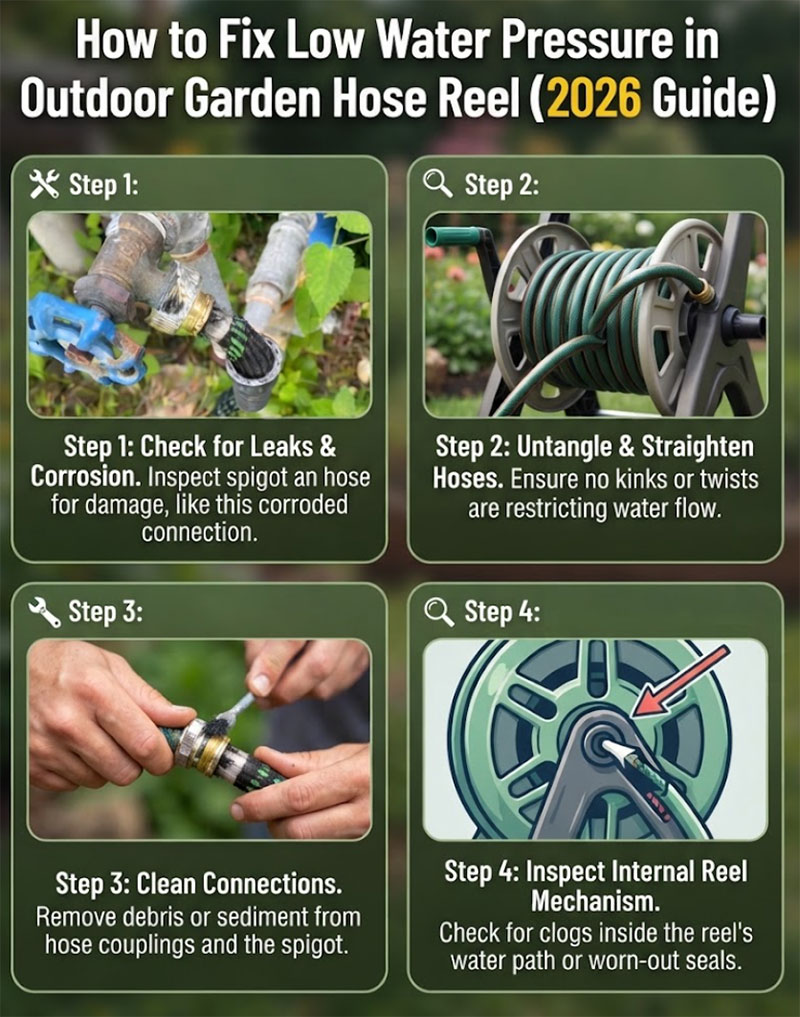
 How to Fix Low Water Pressure in Outdoor Garden Hose Reel
What usually goes wrong
1. Kinks and twists. This is the first thing I’d check. Hoses fold sharply inside a reel, especially when they’re rewound unevenly. Enclosed and retractable reels hide most of the hose, so you can’t see it happening. It tends to show up when the hose is only partly pulled out, or after the reel has sat unused for a long time.
To check, pull the whole hose out and lay it as straight as you can. Look for sharp bends, flattened sections, twisted loops, crushed spots, and any stretch that feels unusually soft or deformed. Then turn the water on with the hose fully extended. If the flow picks up a lot, the way the hose sits in the reel was part of the problem.
2. Mineral and sediment buildup. Water carries minerals and tiny particles, and they collect in fittings over time. This matters most where the water is hard. The swivel connector is a prime spot because everything has to squeeze through it on the way into the reel. Watch for flow that fades gradually, white or chalky deposits, rust-colored debris, a swivel that doesn’t turn smoothly, or small particles falling out when you disconnect it. If the blockage is just removable buildup, cleaning the fitting can bring the flow back.
3. A leaking swivel or tired O-rings. Reels rely on seals to keep water inside at every connection. A damaged, squashed or badly seated washer or O-ring will leak. Check the wall connection, the swivel, the hose inlet, the couplings, the reel outlet and the spray-gun connection. Even a small drip tells you something: if water is escaping before it reaches the end of the hose, the reel will seem to underperform even with a perfectly good supply. Some manufacturers specifically recommend inspecting and replacing damaged swivel seals and O-rings, and they warn against over-tightening.
4. The wrong hose diameter. On long runs, diameter matters. A long, narrow hose creates more resistance than a wider one carrying the same water. One example from the source material is a 1/2-inch feed hose on a 100-foot reel, which can be a bottleneck compared with a 5/8-inch hose. That doesn’t mean every 5/8-inch hose will give you more pressure at the nozzle, since the result depends on your faucet, hose length, fittings, nozzle and demand. But if you need serious flow over a long distance, take diameter seriously.
5. A restricted outdoor faucet. Sometimes the reel is completely innocent. The faucet may have a partly closed shut-off valve, internal corrosion, a clogged aerator or fitting, plumbing restrictions, low household supply, or trouble elsewhere in the water system. Take the reel off and watch the faucet run by itself. If that flow is weak, sort out the supply before you take anything else apart.
6. A blocked nozzle or spray gun. It’s easy to forget the last piece in the chain. A hose can flow beautifully until you attach a restrictive nozzle, and dirt, minerals and small particles can plug the openings. Pull the nozzle off and let the water run straight from the hose. If it’s strong without the nozzle and weak with it, clean or replace the nozzle before you touch the reel.
7. A damaged hose. Old hoses can fail on the inside while looking fine on the outside. Look for internal deformation, collapsed sections, cracks, soft spots, severe wear and permanent kinks. Extreme temperatures and repeated bending in the same spot make it worse. If the hose is damaged, replacing it is usually more practical than repairing it.
Step-by-step fixes
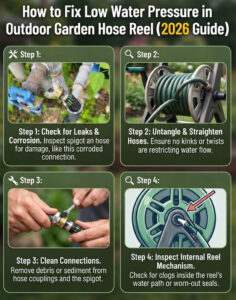
Step 1: Test the faucet first. Disconnect the reel, open the faucet fully and watch the flow. If it’s weak, the issue is the faucet, the shut-off valve, the household plumbing or the supply, and there’s no point dismantling the reel until that’s sorted. If it’s strong, reconnect everything and keep going. This one test can save you a lot of time.
Step 2: Unwind the whole hose. Don’t try to diagnose a long hose while it’s tightly coiled. Straighten it, remove kinks, untwist loops, check for flat spots, then turn the water on and test. If flow improves, the problem is how the hose is wound or positioned.
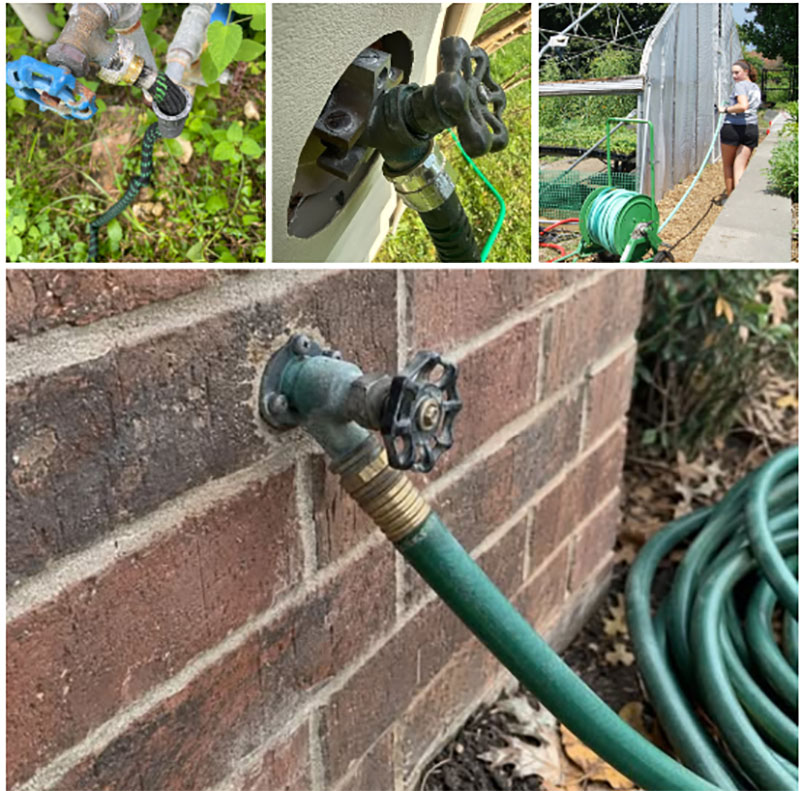
Step 3: Check every connection. Follow the water from start to finish: outdoor faucet → leader hose → swivel → reel hose → outlet connection → nozzle. At each joint, look for leaks, loose fittings, cracked plastic, damaged rubber, corrosion, dirt and mineral buildup. A connection that looks harmless can still cause a real restriction.
Step 4: Inspect and clean the swivel. The swivel lets the reel turn while keeping the water connected, so it’s one of the most important parts. Shut off and disconnect the water before opening or servicing it. Look for dirt, rust, mineral deposits, damaged seals and stiff movement. For surface deposits, clean it following the manufacturer’s instructions, and flush out any debris as you go. If your reel uses a product-specific swivel, read the manual before taking it apart.
Step 5: Replace worn washers and O-rings. Seals can go flat, crack, turn brittle, deform, compress or sit crooked. If one is visibly damaged, replace it rather than trying to revive it. Use the correct size and type, because a random rubber ring won’t necessarily fit. And don’t overtighten, which can damage fittings and seals instead of improving the connection.
Step 6: Check the hose diameter. If the hose is very long and fairly narrow inside, flow can drop noticeably. Think about hose length, internal diameter, faucet capacity, the flow you need, nozzle restriction and how many connectors are in the line. A short 5/8-inch hose and a very long 1/2-inch hose won’t behave the same under the same conditions. If you regularly need high flow for cleaning or irrigation, choosing the right hose size will probably help more than modifying the reel.
Step 7: Test without the nozzle. Remove the spray gun or nozzle and look at the flow straight from the hose. Strong flow means the nozzle or gun is the restriction. Weak flow means keep checking the hose and reel. This isolates the last possible choke point.
The five-minute diagnosis
Test Result Likely cause
Faucet alone Weak Faucet, plumbing or supply
Faucet alone Strong Keep testing
Hose fully extended Flow improves Kink, twist or reel winding
Hose extended Still weak Keep testing
Visible leak Yes Washer, O-ring or fitting
Swivel dirty or restricted Yes Clean or service the swivel
Strong flow without nozzle Yes Nozzle restriction
Hose still weak Yes Hose, reel or diameter issue
Every test rules something out, which beats swapping out the reel and hoping.
Does a hose reel cut your water pressure?
It can contribute to reduced flow, since the whole setup adds hose length, fittings and places for restrictions to hide. But it’s wrong to assume a reel automatically costs you a lot of pressure. Performance depends on the entire path: water supply → faucet → leader hose → swivel → reel hose → connectors → nozzle. If the reel is clean, correctly sized, free of kinks and fitted with properly working parts, it can work perfectly well. A big drop in flow deserves investigation, not an automatic blame on the reel.
How hose diameter affects flow
The longer the hose, the more diameter matters. A smaller internal diameter leaves less room for water, and over a long run, friction and resistance eat into the flow. That’s why long hoses for high-flow jobs need careful selection.
Hose characteristic Typical effect
- horter hose Less resistance
- Longer hose More resistance
- Larger internal diameter Generally better potential flow
- Smaller internal diameter Greater restriction
- Kinked hose Severe local restriction
- Blocked nozzle Restriction at the outlet
Don’t pick a hose size based only on the reel’s outside dimensions. Check the manufacturer’s specifications and think about the flow your job needs.
Is a 5/8-inch hose the answer?
It can be a smart choice when you want good flow, especially over longer distances. The source material specifically recommends a short, heavy-duty 5/8-inch leader hose between the wall spigot and the reel input. But the right size depends on your reel, water supply and use. Before changing sizes, check the reel’s supported hose diameter, its maximum hose length, connection specs, your faucet’s capacity and the manufacturer’s recommendations. Never force a hose or fitting into a reel that wasn’t built for it.
Keeping it working
Keep the hose clean. Dirt that gets into connectors can eventually reach internal parts. Don’t set the fitting down in soil or mud when you disconnect it.
Prevent severe kinks. Guide the hose evenly as you wind it, and don’t let it form tight, repeated bends.
Inspect seals now and then. Replacing an inexpensive seal early can head off leaks and connection trouble.
Keep the swivel moving. If it gets stiff or restricted, take a look. Never force a seized mechanism.
Store the reel sensibly. In hot weather, keep it in the shade. Before freezing weather, drain the water out.
Drain the hose before long-term storage. Water left in fittings can cause trouble when it freezes. If your climate doesn’t freeze, you can skip the winterizing, though draining still makes storage and maintenance easier.
Mistakes to avoid
Buying a new reel right away. Check whether the faucet itself has low flow first.
Ignoring the nozzle. A clogged one can make a good hose look defective.
Cranking everything as tight as possible. That damages seals and fittings.
Overlooking hose diameter. A long, narrow hose is a poor match for high-flow jobs.
Taking the reel apart without reading the manual. Internal mechanisms differ from design to design.
Using a visibly damaged hose. A cracked or badly deformed hose should be replaced, not patched again and again.
Treating every weak stream as a pressure problem. Often it’s restricted flow.
Repair or replace?
Repair usually makes sense when the problem is a washer, an O-ring, a removable blockage, a loose connection or a minor fitting issue. Replacement makes more sense when the reel has a cracked body, a damaged internal mechanism, severe corrosion, a failed non-serviceable valve, a badly damaged hose, repeated failures, or internal damage that would cost nearly as much to fix as a new unit. If the reel is under warranty, check the manufacturer’s warranty process before opening it up.
Troubleshooting checklist
- Test the outdoor faucet without the hose.
- Confirm the faucet is fully open.
- Fully unwind the hose.
- Remove visible kinks.
- Inspect the entire hose.
- Check every connection for leaks.
- Inspect the swivel connector.
- Check the O-rings and washers.
- Clean out accessible debris.
- Test the hose without the nozzle.
- Check hose diameter and length.
- Check the reel manufacturer’s specifications.
- Replace damaged components.
- Replace the reel only if repair is impractical.
When a hose reel suddenly gives you weak flow, don’t assume the reel has died. Start at the beginning of the water path: test the faucet, then check the hose, clear the kinks, look at the swivel, inspect the washers and O-rings, think about hose diameter, and finish with the nozzle. That way you’ll know whether the problem is the reel or something before or after it.
For plenty of people, the fix is as simple as straightening a kink, cleaning a clogged fitting or swapping a worn rubber seal. Bigger damage might justify a new hose or reel, but diagnose the restriction before you spend money on replacements. A five-minute systematic test will tell you far more than cranking the faucet higher and hoping.
FAQ
1. Why is my garden hose reel pressure so low?
Usually it’s a weak outdoor faucet, a kinked hose, sediment in the swivel, a damaged O-ring or washer, an undersized hose, or a restricted nozzle. Test the faucet without the reel first to see whether the trouble starts at the source.
2. Does a hose reel reduce water pressure?
It can contribute, since the setup adds hose length and fittings. But a properly working reel shouldn’t cause a major drop on its own. Kinks, blockages, hose diameter and fittings can make a big difference.
3. Why is my water strong at the faucet but weak at the nozzle?
Something after the faucet is restricting the flow. Check the hose for kinks, inspect the reel and swivel, and test the hose without the nozzle.
4. Can a kinked garden hose reduce water flow?
Yes. A sharp kink narrows the passage and can cut flow significantly. Fully extending the hose and removing sharp bends is one of the easiest troubleshooting steps.
5. Can an O-ring cause low water pressure?
A damaged or poorly seated O-ring can let water escape at a connection and drag down performance. Inspect your seals and replace damaged ones with the correct type and size.
6. Is a 5/8-inch hose better than a 1/2-inch hose?
Not in every case, but a larger internal diameter can give better potential flow, especially over long runs. The right choice depends on hose length, faucet, reel specifications and the flow you need.
7. Should I replace my hose reel if the pressure is low?
Not necessarily. Test the faucet, hose, swivel, seals and nozzle first. If a washer, O-ring or blockage is the cause, fixing that part may be enough. Replace the reel or hose when the damage is substantial.
8. How can I prevent low flow from my hose reel?
Avoid severe kinks, inspect seals regularly, keep connectors clean, use an appropriate hose diameter, maintain the swivel, and store the reel the way the manufacturer recommends.
Editor – Jursika