
The Kandy to Ella Train Ride: Everything You Need to Know Before You Go
There’s a train ride in Sri Lanka that people talk about long after they’ve flown home, and once you’ve done it, you understand why. It winds through mist-covered tea plantations, rattles over century-old stone viaducts, and climbs steadily into the cool air of the island’s central highlands. The route runs from Kandy — the old royal capital — up to Ella, a small mountain town, and takes about seven hours. Travel experts around the world keep naming it one of the most beautiful train journeys on the planet, and honestly, it earns that reputation.
Whether you’re backpacking on a shoestring, traveling in style, or just someone who likes to take things slow, you’ll want a bit of a plan before you show up at the station. Sri Lanka’s rail system isn’t hard to navigate, but it rewards a little preparation. Here’s what I’d tell you if we were grabbing coffee before your trip.
Why This Train Ride Has Become Such a Big Deal
The British built this line back in the 1860s, not for tourists but for coffee and tea — hauling it down from the upcountry estates to the port in Colombo. Over time, that colonial-era freight route turned into one of the most talked-about rail journeys in the world.
Here’s the thing that sets it apart from a bullet train: it’s not built for speed. It crawls along at 25 to 30 kilometers an hour, which sounds slow until you realize that’s exactly the point. You get a front-row seat to rural Sri Lankan life — kids walking to school, farmers in the fields, laundry drying on lines — all passing by close enough to touch.
A few numbers worth knowing:
- Total distance: 156.5 kilometers (about 97 miles)
- Travel time: usually somewhere between 6 hours 45 minutes and 7 hours 30 minutes
- Highest point: Pattipola Station, sitting at 1,897 meters (6,224 feet)
- Tunnels along the way: 46, all hand-carved through stone
The Route: How the Scenery Changes as You Climb
Kandy → Peradeniya → Hatton → Nanu Oya/Nuwara Eliya → Pattipola → Haputale → Ella
Kandy to Hatton — the climb starts here. Leaving Kandy, you roll through suburban greenery and follow the Mahaweli River for a while. As the train gains altitude, the thick tropical forest gives way to neat rows of rubber and tea. Hatton is where most people get off if they’re planning to climb Adam’s Peak.
Hatton to Nanu Oya — this is tea country, full stop. This stretch is the postcard section of the ride. Rolling hills covered in tea bushes as far as you can see, old processing factories from the 1800s still standing, and if you’re on the right side of the carriage, you’ll catch St. Clair’s Falls cascading down the hillside.
Nanu Oya to Pattipola — the highest point on the line. Nanu Oya is your jumping-off point if you want to visit Nuwara Eliya, which people still call “Little England.” From there, the train works hard to reach Pattipola, the highest broad-gauge station in the country. Clouds roll in and out of the carriage here, and the temperature drops fast.
Haputale to Ella — this is where it gets dramatic. After the summit tunnel, the land opens up at Haputale. On a clear day, you can see all the way to the southern coast. From there, the train curves through the mountains and eases into Ella.
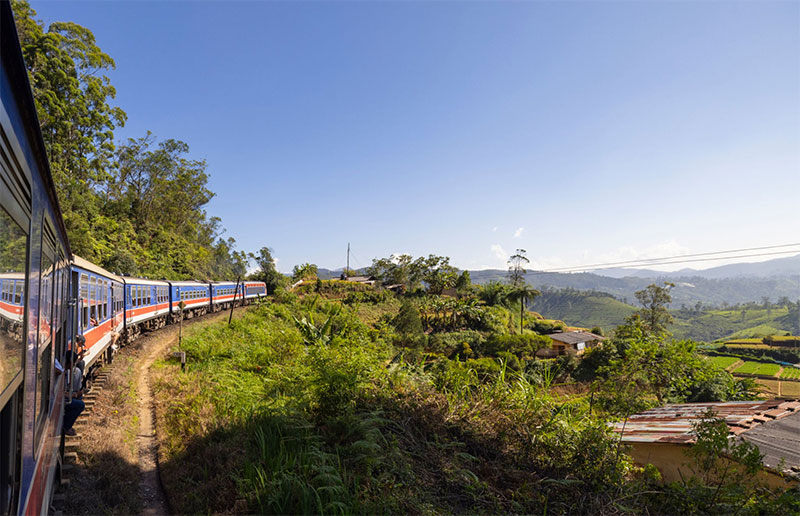 The iconic blue train winding through Ceylon tea country.
Picking the Right Class of Travel
There are a handful of carriage options on this line, and which one suits you really comes down to whether you’d rather be comfortable or have a clear shot for photos.
| Class | Seating | AC | Windows | Best For |
|---|---|---|---|---|
| 1st Class AC | Reserved, reclining | Yes | Sealed glass | Comfort and quiet |
| 2nd Class Reserved | Reserved, padded | No (fans) | Openable windows and doors | Photography plus decent comfort |
| 3rd Class Reserved | Reserved, bench-style | No (fans) | Openable windows | Budget travel with a guaranteed seat |
| 2nd/3rd Class Unreserved | First-come, first-served | No | Openable windows | Flexibility, more local flavor |
| Ella Odyssey Special | Tourist-focused, reserved | Optional | Panoramic access | Sightseeing at major stops |
If you’re chasing photos, go with 2nd Class Reserved. The sealed windows in 1st Class are nice for comfort, but they kill your shots with glare. Rolling the window down in 2nd Class makes a real difference.
Booking Your Tickets
Demand for this route is intense, especially from international travelers, so timing matters.
1. Know your window. Reserved seats open up exactly 30 days before departure, at 8:00 AM Sri Lanka Standard Time. Set a reminder — seats go fast.
2. Pick how you’ll book. You’ve got two solid options: the official e-ticketing portal (seatreservation.railsan.lk), or third-party platforms like 12Go Asia and local travel agents, who’ll charge a small fee for the convenience.
3. Grab your physical ticket. If you booked online, bring your reference code and passport to a station counter — Colombo Fort, Kandy, or Ella all work — and print your boarding pass before the train leaves.
A Few Things That’ll Make Your Trip Easier
Sit on the right side, then switch. From Kandy to Nanu Oya, sit on the right for the best views of the tea estates and St. Clair’s Falls. Once you pass Nanu Oya heading to Ella, move to the left — that’s where the cliffside views near Haputale and Idalgashinna are.
Bring your own snacks and water. Vendors do come through selling wade (lentil fritters), peanuts, and tea, and it’s worth trying, but seven hours is a long time to rely entirely on what happens to walk by.
Pack a layer. Once you climb past 1,500 meters, the temperature drops noticeably. A light windbreaker or fleece will save you, especially if you’re standing near an open window.
Be smart at the doors. Everyone wants that photo standing in the open doorway, and fair enough, it’s a great shot. Just keep your wits about you — tree branches, tight tunnel entrances, and sudden braking are real hazards. Always keep a solid grip on the handrail.
Don’t Miss the Nine Arch Bridge
Between Ella and Demodara, you’ll cross the Nine Arch Bridge — sometimes called the Bridge in the Sky. It’s a genuinely impressive piece of colonial engineering: built entirely from brick, stone, and cement, no structural steel at all, spanning 91 meters over a jungle valley.
Approximate train timings at the bridge:
- Morning: ~9:15–9:30 AM (express passenger train)
- Midday: ~11:45 AM–12:15 PM (Ella Odyssey service)
- Afternoon: ~3:30–4:00 PM (local upcountry service)
Keep in mind Sri Lankan train schedules run loose. Get to the lookout point about 45 minutes before the train’s expected, just to be safe.
Questions People Usually Ask
What’s the most scenic stretch of the ride? The whole route is worth it, but the section between Nanu Oya and Haputale is the standout — high-altitude cloud forest, tea plantations, and some genuinely steep valley drops.
Can I just buy a ticket on the day I travel? Yes. Unreserved 2nd and 3rd class tickets are sold at station counters the day of travel, usually an hour or two before departure, and they never sell out. The catch is you’re not guaranteed a seat, and the carriages can get packed.
What does it actually cost? It’s genuinely cheap. Unreserved tickets run $1.50 to $3.00 USD (LKR 500–1000). Reserved 2nd and 3rd class seats are $4.00 to $8.00. If you want 1st class or a tourist train like the Ella Odyssey, expect to pay $10.00 to $20.00.
Should I go Kandy to Ella, or the other way around? The scenery’s identical either direction. Kandy to Ella is a bit more popular simply because it fits the typical south-bound route most travelers take through Sri Lanka.
Are there bathrooms on board? Yes, every carriage has one. First class gets a proper western-style toilet; 2nd and 3rd class usually have a mix of squat and basic western options. Bring your own tissue and hand sanitizer, just in case.
The Bottom Line
This isn’t just a way to get from point A to point B — it’s a slow-moving window into Sri Lanka’s history, landscape, and daily life, all in one ride. Give yourself the seven hours. It’s the kind of thing that ends up being the highlight people remember most from the whole trip.