
Give the Cultural Triangle three days if you’re tight on time, four for the comfortable version, five to add an ancient city and an elephant safari — and base yourself in Sigiriya or Habarana for all of them. The Triangle is Sri Lanka’s ancient heartland: the area between the island’s old capitals of Anuradhapura and Polonnaruwa in the north-central dry zone and Kandy in the hills, with the rock fortress of Sigiriya and the cave temples of Dambulla standing inside it. In three days you can climb Sigiriya at sunrise, cycle the ruins of Polonnaruwa, and see the painted caves of Dambulla; in five you add the vast sacred city of Anuradhapura and a jeep among hundreds of wild elephants.
This guide ranks the sites honestly (some of the region’s famous ruins are skippable), gives current 2026 ticket prices — including the confusing situation with the combined “Round Ticket” — settles the where-to-stay question, provides complete itineraries at three lengths, and explains the Coconut Triangle, which is a completely different part of Sri Lanka that people routinely mix up with this one.
| Question | Answer |
| How many days? | 3 for the essentials, 4 comfortable, 5 with an ancient city and safari |
| Best bases | Sigiriya village or Habarana (Dambulla as the budget alternative) |
| Must-sees | Sigiriya at dawn, Polonnaruwa by bicycle, Dambulla caves |
| Best months | December–February for comfortable heat; June–September for the elephant Gathering |
| Ticket budget per adult | Roughly $60–95 across the major sites (see the ticket section — this changed recently) |
| Getting around | A driver for the region, bicycles inside Polonnaruwa |
| Kandy? | The Triangle’s southern point — most trips add 1–2 nights there |
What Is the Cultural Triangle?
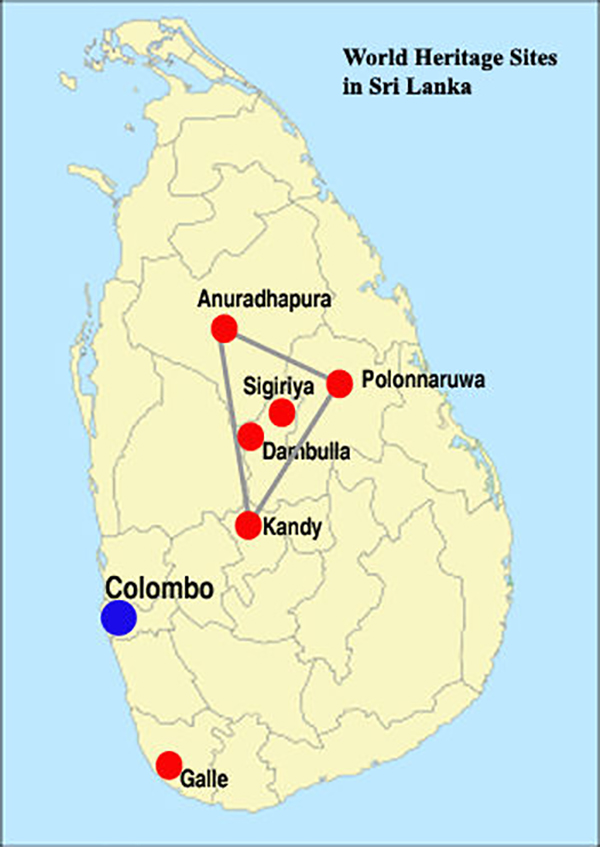
The name describes a triangle drawn between three of Sri Lanka’s capitals: Anuradhapura, the island’s first great capital from the 4th century BC; Polonnaruwa, the medieval capital that followed it; and Kandy, the last royal capital in the hills. Inside and around that triangle sit the sites most travelers actually come for: Sigiriya, the 5th-century rock fortress rising 200 meters from the jungle; Pidurangala, the monk’s rock opposite it; Dambulla’s five cave temples, painted across centuries; and a scattering of lesser ruins — Mihintale, Ritigala, Nalanda Gedige — that reward travelers with extra time.
Two practical facts define the region. First, it’s the dry zone: this is the hottest, driest part of your Sri Lanka trip, which is why every itinerary in this guide puts climbs at opening time. Second, it’s compact: Sigiriya, Dambulla, Polonnaruwa, and Habarana sit within about an hour of each other; Anuradhapura and Kandy are each a half-day’s drive from that cluster. The Triangle works as a 3–5 day standalone trip or as the first act of a longer Sri Lanka loop.
The Sites, Ranked Honestly
The Essentials
Sigiriya Lion Rock. The region’s masterpiece and Sri Lanka’s single most famous sight. A 1,200-step climb up a rock whose western face once held a palace; midway you pass frescoes of celestial maidens painted in pockets of the rock; at the top, foundations of a 5th-century royal citadel and a view that explains why King Kasyapa chose it. Climb at the 7 a.m. opening — for the mist in the valley, the heat you avoid, and the tour groups you beat. Take water and a hat. Allow 2.5–3 hours.
Polonnaruwa. The medieval capital, and the one ancient city that rewards casual visitors. The ruins are compact, connected, and best experienced by bicycle — you rent one in town, ride between the palace complex, the vatadage (a circular relic house with gorgeous moonstones), the Gal Vihara’s three colossal Buddhis carved from a single granite wall, and the lotus-bowl-shaped Rankoth Vihara. Buy your ticket at the Archaeological Museum and visit the museum first — twenty minutes there turns a field of ruins into a city you can read. Allow a full, unhurried morning.
Dambulla Cave Temple. Five caves in a rock face above the plains, filled with 150-plus Buddha statues and murals covering the ceilings — a working temple for over two thousand years and the best-preserved cave-temple complex on the island. It’s a 15–30 minute climb up steps (socks off at the top; it’s a sacred site) and pairs perfectly with a Sigiriya-area morning or the drive north. Allow 1.5–2 hours.
Worth It with Extra Time
Anuradhapura. The first capital and a living sacred city — whitewashed stupas the size of hills, the Sri Maha Bodhi (a sacred fig tree grown from a cutting of the Buddha’s own tree, tended for over two millennia), and monastic ruins spread across a large area best toured by tuk-tuk or bicycle with a driver-guide. It’s the deepest historical experience in the region, but it demands a full day and rewards those who arrive with some context. If you’re choosing between the two ancient cities on a short trip, most travelers find Polonnaruwa the easier love and Anuradhapura the deeper one.
Minneriya or Kaudulla National Park. Between roughly June and September, the receding Minneriya reservoir draws one of Asia’s great wildlife spectacles — the Gathering, hundreds of elephants converging at dusk. Jeep safaris run from Habarana and Sigiriya in half a day. Udawalawe, farther south, is the year-round elephant alternative.
Pidurangala. The rock opposite Sigiriya, crowned with a reclining Buddha and offering the classic sunset view of Sigiriya itself — at a fraction of the price. Many travelers climb Sigiriya at dawn and Pidurangala at dusk on the same day, and call it the perfect pairing.
For the Connoisseur
Mihintale. The mountain where Buddhism is said to have arrived in Sri Lanka in the 3rd century BC — a climb of 1,840 steps to a hilltop of white stupas and monastic ruins, 13 km from Anuradhapura. Cheap, uncrowded, and genuinely moving. Ritigala. A monastery ruin in a forested nature reserve — no crowds, no tickets for the sacred mountain’s lower slopes (a small fee applies), and an atmospheric hour among meditation platforms. Nalanda Gedige and the Avukana Buddha, a standing colossus, round out the deep cuts.
What You Can Skip
The region’s completeness is a trap. If time is short, skip Anuradhapura rather than rushing it (a compressed Anuradhapura is the least rewarding version of it), skip the region’s minor museums beyond Polonnaruwa’s, and don’t double up both Pidurangala and a second Sigiriya climb “for photos.” And unless you have five days and a specific interest, choose one ancient city — not both.
Tickets and Fees: What the Cultural Triangle Costs
This section matters more than most guides admit, because the region’s ticketing changed recently and much of the internet — including high-ranking guides — still prints the old story.
Per-Site Prices (2026)
Heritage tickets are set by the Central Cultural Fund (CCF), quoted in US dollars, and collected in rupees at the day’s exchange rate. SAARC passport holders (India, Pakistan, Bangladesh, Nepal, Bhutan, Maldives, Afghanistan) pay roughly half with a passport shown at the counter; children 6–12 pay half rates; under-6s enter free.
| Site | Foreign adult (approx.) | Notes |
| Sigiriya | USD 30–35 | Sources currently conflict between $30 and $35 — verify at the gate |
| Polonnaruwa | USD 25–30 | Includes the Archaeological Museum |
| Anuradhapura | USD 25–30 | Mihintale is separate and far cheaper |
| Dambulla Cave Temple | Roughly USD 6–15 | Paid in rupees at the base of the rock; sources conflict |
| Mihintale | Under LKR 1,000 | Department of Archaeology, not CCF |
| Minneriya/Kaudulla safari | USD 25–30 park fee + jeep | Jeep is per vehicle, not per person |
Treat every figure as a planning band. Fees are gazetted rather than seasonal — they change by government revision, without notice.
The Round Ticket Situation
For years, the region ran on a combined “Cultural Triangle Round Ticket” — around USD 50 covering Sigiriya, Polonnaruwa, Anuradhapura, and Dambulla — and a great many guides and booking pages still advertise it. Here is the honest current picture:
- The CCF’s official e-ticketing pages have continued to describe a Round Ticket product, and some recent planning resources still price it near USD 50.
- At the same time, on-the-ground reporting from within Sri Lanka in 2026 — checked against the CCF’s own published price table — states that the old combined ticket no longer appears on the official price list, that sites are ticketed individually, and that travelers have been left short at counters after budgeting for a bundle that couldn’t be sold to them.
The practical guidance, whichever version is true on your travel date: budget per site (the table above), and ask at the first CCF counter you reach whether a Round Ticket is currently available and what it covers. If one exists on your dates, it’s a pleasant saving; if it doesn’t, your plan still works. Never buy tickets from touts or drivers outside the official counters.
Rules That Shape Your Itinerary
Three rules matter more than the prices:
- Every ticket is single-entry, single-day. There is no multi-day pass at any site. Two days at Anuradhapura means two full-price tickets — which is why this guide gives Anuradhapura one dedicated day.
- The CCF e-ticketing order is not the ticket. You can order online (the order is valid 90 days), but you still collect the physical ticket at the site counter with your receipt number, and payments are non-refundable.
- Carry cash. Travelers consistently report card payments failing at heritage counters — a declined card at 7 a.m. with a driver waiting is a bad start to the day. Counters are open roughly 7:00 a.m. to 5:00 p.m. daily.
Cultural Triangle Weather and the Best Time to Go
The Triangle sits in Sri Lanka’s dry zone, so the monsoon logic that governs the rest of the island barely applies here. The real variable is heat:
- December–February: the comfortable window — dry, warm rather than hot, and mornings pleasant enough that the 7 a.m. Sigiriya climb is genuinely enjoyable. Peak season prices apply.
- March–September: still mostly dry, and increasingly hot — by March–May the midday hours in the dry zone are seriously hot (regularly into the low-to-mid 30s°C). This is also the season for the Minneriya elephant Gathering (roughly June–September), which is why many travelers accept the heat.
- October–November: the inter-monsoon is the one genuinely unreliable window anywhere in Sri Lanka, and the Triangle can get heavy rain and even flooding. If you travel then, keep plans flexible.
- April–May and September–October: the value windows — drier than the calendar suggests, cheaper than peak, thinner crowds.
Two practical notes: heat, not rain, is what you plan around here — every itinerary below puts the climbs at opening time and the drives in the air-conditioned middle of the day. And because the region is dry, the morning light for photography is outstanding nearly year-round. (Our full best-time guide covers how the Triangle fits the rest of the island’s seasons.)
Where to Stay: Sigiriya, Dambulla or Habarana?
The Triangle’s accommodation clusters in three areas, and the choice shapes your days:
Sigiriya village — the premium option. Small, green, and quiet, with the rock fortress in view and a cluster of hotels from mid-range to the famous properties: Heritance Kandalama (Bawa’s architectural masterpiece built into the rock face above a reservoir) and Jetwing Vil Uyana (dwellings set in a man-made wetland). Best for travelers who want the 7 a.m. climb to be a ten-minute drive away, and for whom a beautiful hotel is part of the point.
Habarana — the pragmatic base. A village at the region’s crossroads, 20 minutes from Sigiriya, 30 from Polonnaruwa, and the safari-jeep hub for Minneriya and Kaudulla. Mid-range hotels, good value, and the shortest total drive times. Best for 3-day itineraries and safari-first trips.
Dambulla — the budget and logistics option. A real working town on the main road, with cheaper guesthouses and easy onward transport; the cave temple is next door. Best for backpackers and travelers moving by public transport.
The rule of thumb: one base for the whole region — the Triangle is small enough that changing hotels costs more time than it saves. Sigiriya or Habarana for most trips; two nights minimum, three for the 4–5 day versions.
Getting Around: Drivers and Bicycles
Within the region, a driver is the standard. The Triangle’s sites sit 30–75 minutes apart on dry-zone roads, and a car with driver ($55–75 per day, fuel and the driver’s costs included) is how nearly every visitor moves — our practical guide to hiring one covers rates and what to check. Budget travelers can do the region by bus and tuk-tuk (Dambulla is the hub), and our driver-free travel guide explains how, at the cost of a slower pace.
Inside Polonnaruwa, bicycles. The ancient city is flat, compact, and rideable — rental shops line the road by the museum, bikes cost a few dollars a day, and riding between the quadrangle, the palace, and the Gal Vihara with the wind in your face is everyone’s favorite day. Hire a tuk-tuk or bicycle at Anuradhapura too — the sacred city is too big to walk.
The 3-Day Cultural Triangle Itinerary
The essentials version — the one that fits inside a longer Sri Lanka trip.
- Day 1: Sigiriya. Arrive from Colombo/Kandy (3.5–4 hours from Colombo; 2.5 from Kandy). Afternoon at Dambulla Cave Temple when the day-trippers have gone, or the pool if the heat is fierce. Evening: sunset from Pidurangala.
- Day 2: Polonnaruwa. Early start (30–45 minutes from Habarana/Sigiriya). Museum first, then cycle the ancient city until early afternoon. Afternoon: Ritigala’s forest monastery on the way back, or rest.
- Day 3: Sigiriya at dawn + safari. Lion Rock at the 7 a.m. opening — cool, misty, and before the crowds. Late morning departure onward (to Kandy for the hill country, or back toward Colombo). If elephants outrank ancient cities for you, swap Day 2 for an afternoon Minneriya safari.
What a 3-day trip costs you: Anuradhapura entirely, and any sense of haste-free mornings.
The 4-Day Cultural Triangle Itinerary
The comfortable version — same core, one fewer compromise.
- Day 1: Arrive; Dambulla caves; sunset at Pidurangala. Overnight Sigiriya or Habarana.
- Day 2: Sigiriya at dawn. Afternoon: Minneriya or Kaudulla safari (in Gathering season, this is the day to do it). Overnight same base.
- Day 3: Polonnaruwa by bicycle — museum first, the full loop. Overnight same base (or move to Polonnaruwa town).
- Day 4: Choose your depth: Anuradhapura as a full day en route to Kandy (it’s roughly on the way — barely), or Mihintale in the morning and a relaxed drive south.
The 5-Day Cultural Triangle Itinerary
The full region — the version for travelers who love history, or who want the Triangle plus wildlife without rushing.
- Days 1–2: As the 4-day version — Dambulla and Pidurangala, then Sigiriya at dawn and a safari afternoon.
- Day 3: Polonnaruwa by bicycle; Ritigala on the return. Overnight Habarana or move to Anuradhapura.
- Day 4: Anuradhapura — the sacred city by tuk-tuk or bicycle with a guide: the Sri Maha Bodhi, the great stupas, Isurumuniya. Add Mihintale late afternoon if the spirit moves. Overnight Anuradhapura.
- Day 5: Morning: Avukana Buddha or Nalanda Gedige on the road south. Depart for Kandy (3–3.5 hours) — the Triangle’s southern point and the natural next stop.
The 5-day version links to the rest of the island cleanly: Kandy onward by train through the hills, or the road back to Colombo via the Coconut Triangle drive — more on that below.
The Route, Mapped
There’s no need for a printed map to follow the logic — the region is a small cluster with two outliers:
- The cluster: Dambulla (southwest corner) → Sigiriya (15 minutes east) → Habarana (20 minutes north) → Polonnaruwa (45 minutes east of Habarana)
- The outliers: Anuradhapura and Mihintale 1.5 hours northwest of Habarana; Kandy 2.5–3 hours south
- The classic route (any itinerary): enter from the south (Colombo or Kandy), sleep in the Sigiriya–Habarana cluster, day-trip outward, exit south to Kandy
A dedicated route map image (see the image plan) is worth producing for this article — “Sri Lanka Cultural Triangle map” is a direct search need, and a clean, labeled map earns links and featured placements.
The Coconut Triangle: A Different Triangle Entirely
Search “Sri Lanka triangle” and you’ll meet two of them, and they are not the same place. The Cultural Triangle is the ancient-capital region this article covers. The Coconut Triangle is the island’s coconut-growing heartland in the wetter west — the area between Colombo, Chilaw, and Kurunegala, covering the districts of Kurunegala, Puttalam, and Gampaha. It’s an agricultural term, not a tourist one.
The facts (from Sri Lankan agricultural research, worth knowing because they surprise people): roughly a quarter of Sri Lanka’s cultivated land — over 400,000 hectares — is under coconut, second only to rice. Around 55–75% of that coconut land sits inside the Coconut Triangle (figures vary by source and year), with Puttalam district alone devoting around 70% of its agricultural land to the crop. The island produces on the order of three billion coconuts a year, most consumed domestically. Coconut is Sri Lankan cuisine’s everything — milk in every curry, oil, the sambol beside your hoppers, and the king coconut water you’ll drink at every roadside stop.
Will you visit the Coconut Triangle? Unknowingly, probably yes: the drive from Colombo or Negombo toward the Cultural Triangle runs straight through it, hours of coconut palms in ranks. There’s nothing to “see” as a destination — no ticket, no viewpoint — but the plantations are the landscape, and the small-scale coconut estates, mills, and toddy tappers climbing the palms at dusk are part of what the drive north actually is. If a coconut-plantation experience matters to you, ask your driver to stop at a working estate or a coir (coconut fiber) workshop; some offer short visits.
So: Cultural Triangle for the ancient cities, Coconut Triangle for the scenery on the way there — and now you can tell them apart.
Guidebooks
The “Cultural Triangle of Sri Lanka book” search usually means one of two things. If you want a guidebook covering the region: the most detailed is Bradt’s Sri Lanka (the current 7th edition), which treats the Cultural Triangle’s sites with proper depth; Lonely Planet’s Sri Lanka covers the essentials in less space. If you mean the historical art book — Cultural Triangle of Sri Lanka photography volumes exist covering the region’s monuments — secondhand and library copies are the realistic route. For a trip, honestly: this article plus a downloaded offline map will do the planning work; carry the book for the evenings.
Three days for the essentials, four to breathe, five for Anuradhapura and the elephants — with one base in Sigiriya or Habarana, climbs at 7 a.m., a bicycle in Polonnaruwa, and cash in your pocket for the counters. The Cultural Triangle is the most concentrated dose of ancient history anywhere in South Asia, and it earns its place at the start of almost every Sri Lanka itinerary.
The two decisions that follow the region are where to go next — Kandy and the hill country is the classic continuation — and how to get there, which our complete Sri Lanka travel guide covers along with everything else.
FAQ
How many days do you need for the Cultural Triangle?
Three days for the essentials (Sigiriya, Polonnaruwa, Dambulla), four for the comfortable version with a safari, five to add Anuradhapura and the connoisseur sites. Base yourself in Sigiriya or Habarana for all lengths.
What is the Cultural Triangle of Sri Lanka?
The region between Sri Lanka’s ancient capitals — Anuradhapura and Polonnaruwa in the north-central dry zone and Kandy in the hills — containing Sigiriya, Dambulla, and lesser ruins. It holds four UNESCO World Heritage sites and the island’s densest concentration of ancient history.
How much do Cultural Triangle tickets cost?
Roughly $30–35 for Sigiriya, $25–30 each for Polonnaruwa and Anuradhapura, and a few dollars to $15 for Dambulla (paid in rupees) — around $60–95 per adult for the major sites. SAARC passport holders pay roughly half with a passport shown.
Does the Cultural Triangle Round Ticket still exist?
This is genuinely uncertain as of late 2026. The old ~$50 combined ticket is still advertised on many sites and has appeared on official CCF pages, but on-the-ground reporting says it no longer appears on the Central Cultural Fund’s published price list and that sites are ticketed individually. Budget per site and ask at the first official counter.
Where should I stay in the Cultural Triangle?
Sigiriya village for the premium option (the rock is minutes away; Heritance Kandalama and Jetwing Vil Uyana anchor the area), Habarana for value and safari access, Dambulla for budget and public transport. One base for the whole region — it’s compact.
When is the best time to visit the Cultural Triangle?
December–February for comfortable temperatures, June–September for the Minneriya elephant Gathering. March–September is hot but dry — climb at the 7 a.m. opening. October–November (inter-monsoon) is the least reliable window.
Can you cycle Polonnaruwa?
Yes, and you should — the ancient city is flat and compact, with rental bikes available near the Archaeological Museum for a few dollars a day. Visit the museum first; it turns the ruins into a story.
Is Kandy part of the Cultural Triangle?
Yes — Kandy is the Triangle’s southern point, though it sits two-plus hours from the core sites. Most itineraries do the Triangle first and add one or two nights in Kandy before continuing into the hill country.
What is the Coconut Triangle?
A completely different region: the coconut-growing area between Colombo, Chilaw, and Kurunegala in the island’s west, which holds over half of Sri Lanka’s coconut plantations. It’s not a tourist destination — but the drive from Colombo to the Cultural Triangle passes straight through it.
EXTERNAL SOURCE RECOMMENDATIONS
Claims in the article that should carry (or be verified against) authoritative outbound links at publish time:
- Ticket prices and the Round Ticket situation: Central Cultural Fund — https://ccf.gov.lk (the official price table, the e-ticketing pages, and the contact numbers; this is the single most important verification for the article). The Round Ticket contradiction should be handled transparently in the text, citing the CCF’s own pages.
- Mihintale and Ritigala (Department of Archaeology sites): Department of Archaeology — http://www.archaeology.lk
- UNESCO status of the sites: UNESCO World Heritage List — https://whc.unesco.org/en/statesparties/lk
- Minneriya/Kaudulla safari fees and the Gathering: Department of Wildlife Conservation — https://www.dwc.gov.lk
- Coconut Triangle facts (extent, share of production, districts): Coconut Research Institute — http://www.cri.lk, plus the academic sources that quantify the triangle (Springer’s intercropping review and the Sri Lankan agricultural statistics above); cite one authoritative figure range rather than a precise number.
- Weather and dry-zone climate: Sri Lanka Department of Meteorology — http://www.meteo.gov.lk
- Inter-monsoon caution: UK FCDO — https://www.gov.uk/foreign-travel-advice/sri-lanka (flooding warnings, October–November)
- Sigiriya historical facts (5th century, Kasyapa, 1,200 steps): UNESCO description and the CCF’s own Sigiriya pages.
Related Articles
- Travel Checklist: Essential Packing and Trip Preparation Guide
- Sri Lanka Packing List: What to Pack for Any Trip (2026)
- Is Sri Lanka Safe to Visit? A Straight Answer for 2026
- Getting Around Sri Lanka: Transport Guide (Trains, Drivers, Apps)
- Travel Checklist: Essential Packing and Trip Preparation Guide
- Sri Lanka Cultural Triangle Itinerary: 3, 4 or 5 Days (2026)
- Sri Lanka Honeymoon Itinerary: 5, 7 or 10 Days (2026 Guide)
- what to see in sri lanka in 7 days
- How much money to take to Sri Lanka for 2 weeks: Sri Lanka Travel Budget (2026 Costs)
- Best Time to Visit Sri Lanka: A Month-by-Month Guide for Every Trip
- Sri Lanka Visa for US Citizens: The Complete 2026 ETA Guide
- how to be a travel guide in sri lanka : Itineraries, Costs, Visas & Tips
Editor – Jayamanna