
What to Know Before You Go
Plan your trip with this sri lanka travel guide: best time to visit, 2026 ETA visa rules, safety, 7 to 14 day itineraries, transport, and costs.
Sri Lanka packs a continent’s worth of travel into an island you can cross in a day. You can wake up at a fifth-century rock fortress rising out of the jungle, spend the afternoon watching tea estates roll away in green waves, and finish the day with rice and curry and your feet in the sand. The catch is that people who try to do too much end up worn out by the roads. The ones who plan around the island’s geography tend to come home saying it was the best trip they’ve ever taken.
This is the planning page we wish we’d had before our first visit. It covers when to go (the answer depends on which coast), how the visa works after the 2026 rule change, an honest look at safety, realistic itineraries for 7 to 14 days, how to get around without losing days, and what it all costs.
If you only remember three things, make them these. Apply for your ETA online before you fly, because it’s now required in advance, though it’s free for 40 nationalities, including the US, UK, EU, Australia, Canada, India, and China. Aim for at least ten days. And match your month to the right coast.
Sri Lanka at a Glance
Sri Lanka is a teardrop-shaped island just off the southern tip of India. It’s about the size of Ireland or West Virginia, with roughly 22 million people. The capital region is Colombo, the currency is the Sri Lankan rupee (LKR), and you’ll find English widely spoken in tourist areas alongside Sinhala and Tamil. The country is mostly Buddhist, with significant Hindu, Muslim, and Christian communities.
Here are quick answers to the questions everyone asks first:
- Do I need a visa? Yes. Every foreign visitor needs an Electronic Travel Authorization (ETA) approved before arrival. Since 25 May 2026, tourists from 40 countries, including the US, UK, most of the EU, Australia, Canada, India, and China, get a 30-day tourist ETA for free.
- Is it safe? For the vast majority of trips, yes. Western governments advise standard caution (the US rates Sri Lanka Level 2, the same as many popular destinations) and flag monsoon flooding and remote areas in the north. More on that below.
- When should I go? December to April for the south coast, west coast, and hill country. May to September for the east coast and north. No month is bad, only wrong for a particular coast.
- How many days? Ten is the sweet spot for a first trip with culture, hills, and beach. With fourteen you can add the ancient cities, a safari, or the east.
- How do I get around? Most independent travelers mix scenic trains with a private driver, either a car-plus-driver package or a driver hired as needed.
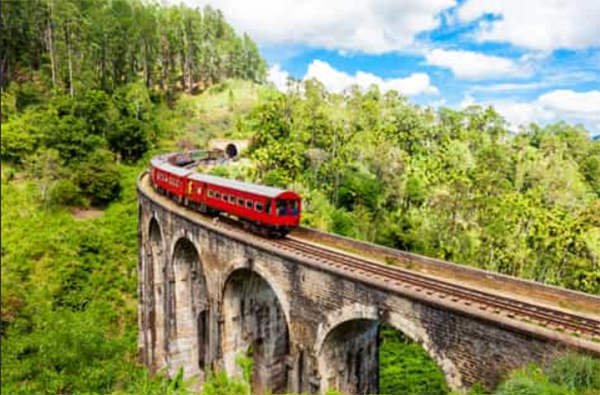 The iconic train ride through Ella’s lush highlands.
When to Visit
First-timers most often make the mistake of treating Sri Lanka as a one-season destination. The island sits close to the equator, so it’s warm all year. The thing that really changes is the rain, and that depends on which side of the island you’re standing on.
The Two Monsoons, Explained Simply
Two monsoon systems hit different halves of the island at different times:
- The southwest monsoon (roughly May to October) soaks the south and west coasts and the hill country. You’ll still get plenty of sunny days between downpours, but the seas get rough and beach time is unreliable.
- The northeast monsoon (roughly December to March) hits the east coast and the north, while the southwest enjoys its driest, sunniest stretch.
In practice, December to April is prime time for Colombo, Galle, Mirissa, the southern beaches, and the hill country. May to September is prime time for Arugam Bay, Trincomalee, and Jaffna. The Cultural Triangle sits in the dry zone and works almost year-round, though it’s hottest from about March to September.
There’s also an inter-monsoon stretch, roughly October to November, when heavy rain and even flooding can hit either side. Official travel advice in late 2026 specifically flags inter-monsoon flooding and landslides. If you’re traveling then, leave some slack in your plans and keep an eye on local weather advisories.
Region-by-Month Planning Table
| Month | South & West Coast | Hill Country | Cultural Triangle | East & North |
|---|---|---|---|---|
| Jan–Apr | Excellent, peak season | Excellent, dry with cool mornings | Very good (hotter by April) | Mixed, northeast monsoon tails off |
| May–Sep | Mixed, southwest monsoon | Mixed, rain likely, views moody | Hot but mostly dry | Excellent, east coast prime time |
| Oct–Nov | Unpredictable, inter-monsoon rain | Unpredictable, landslide risk possible | Usually fine | Improving |
| Dec | Excellent, season starts | Excellent | Very good | Mixed, monsoon season |
A good rule of thumb: pick your coast first, then your month. If your dates are locked in for July, plan around the east coast. If it’s February, head south.
Visas and Entry Requirements (2026)
Entry rules changed in a big way in 2026, and plenty of older guides online still describe the old system, so read this part carefully.
The Free 30-Day ETA for 40 Countries
After a cabinet decision and a gazette notification that took effect on 25 May 2026, nationals of 40 countries can get a 30-day tourist ETA at no charge. The list includes the United States, United Kingdom, Canada, Australia, New Zealand, France, Germany, Spain, Italy, the Netherlands, Sweden, Switzerland, Austria, Belgium, Denmark, Finland, Norway, Czech Republic, India, China, Japan, South Korea, Thailand, Malaysia, Indonesia, Singapore, Russia, UAE, Saudi Arabia, Qatar, and others. The free ETA allows two entries within its 30-day validity, and children under 12 of any nationality also get a free 30-day ETA.
A few details matter:
- You still need an approved ETA before you travel. The scheme drops the fee, not the application. If your country isn’t among the 40, or you’re from a small set of countries that includes Afghanistan, Cameroon, Ghana, Ivory Coast, Nigeria, and Syria, different and stricter processes apply. Check the official site for your nationality.
- No more ETA on arrival. You can’t get one at Colombo’s Bandaranaike International Airport anymore. Apply online ahead of time. Current advice from several governments now says so explicitly.
- Extensions are possible. After you arrive, you can extend a tourist stay beyond 30 days, up to six months in total, through Sri Lanka’s immigration e-services. There’s a fee.
- Passport validity. Your passport needs to be valid for at least six months past your arrival date, with at least one blank page.
- Use the official site only: eta.gov.lk. Third-party “visa services” add markups they don’t need to, and fake ETA sites are a known scam.
If you’re from the Maldives, Seychelles, or Singapore, reciprocal arrangements also give you a free ETA (90 days for Maldivians).
Is Sri Lanka Safe Right Now?
People ask this constantly, and vague reassurance doesn’t help anyone plan, so here’s a straight answer.
Yes, for the overwhelming majority of trips, with ordinary travel caution. Sri Lanka gets large numbers of tourists and most visits go smoothly. Several Western governments do currently advise extra care, though, so here’s what they say and what it means on the ground.
What the Official Advisories Say
As of October 2026:
- The US State Department rates Sri Lanka Level 2, Exercise Increased Caution, citing civil unrest, terrorism, and landmines. Many popular destinations carry the same level.
- The UK’s FCDO does not advise against travel to Sri Lanka. Its focus is practical: inter-monsoon flooding and landslides, standard terrorism vigilance, and petty crime.
- Australia and Canada both advise a high degree of caution, with similar framing.
The same themes run through all of them. Avoid demonstrations, which flare up occasionally and can snarl traffic. Stay alert in crowded places. And be careful in the far north and east, where old landmines from the civil war may remain in remote, off-road areas. That sounds scarier than it is. For tourists it boils down to one rule: stay on main roads and marked trails in the Northern Province, and don’t wander into uncleared fields or forest.
Health and Practical Precautions
- Dengue is a year-round risk that climbs during monsoon season, so use repellent religiously. The CDC also recommends being up to date on routine vaccines and considering hepatitis A and typhoid, both standard suggestions for the region.
- Tap water isn’t reliably safe. Stick to bottled or filtered water, and that includes brushing your teeth in some areas.
- Roads are the biggest everyday risk. Driving is aggressive, and official advisories single out public buses as unsafe because of how they’re driven. Trains and hired drivers are safer.
- Petty crime exists, including pickpocketing and the occasional hotel theft, and there have been reports of drink-spiking. The usual rules apply: don’t leave drinks unattended, use ATMs inside banks or hotels, and be skeptical of gem and jewelry “deals,” a classic Sri Lankan scam.
- Swim carefully. Beaches are often unsupervised, and riptides are a real danger, especially in monsoon season on the affected coast.
Sri Lanka also runs a 24-hour tourist hotline, 1912, operated by the tourism authority. Save it in your phone.
Women, including solo female travelers, can run into harassment. That’s a real issue and it deserves an honest mention rather than a brush-off. Our guide to solo female travel in Sri Lanka goes into practical strategies.
How Many Days Do You Need?
Sri Lanka punishes over-planners. Distances look small on the map, but average road speeds are low, and the regret we hear most is trying to cram the whole island into a week.
| Trip length | What’s realistic | What to skip |
|---|---|---|
| 5–7 days | One region pair: Cultural Triangle + Kandy, or hills + south coast | The far north, safaris you’d have to race to, more than two “bases” |
| 8–10 days | The classic loop: Cultural Triangle → Kandy → Ella → south coast | Anuradhapura and Polonnaruwa (pick one ancient city or none), the east coast |
| 12–14 days | Classic loop plus safari time, Galle at leisure, or the east/north | Very little. This is the pace the country deserves |
| 15+ days | Everything above, plus Jaffna, Trincomalee, or slow beach weeks | — |
Here’s a handy way to think about it: every hotel change eats most of a day. A 10-day trip with four bases feels like six days of actual experience. Fewer bases, longer stays.
Where to Go: The Five Regions
The Cultural Triangle
The dry-zone plains of the north-central interior are home to Sri Lanka’s ancient kingdoms. Sigiriya, a fifth-century rock fortress that rises about 200 meters out of the jungle, is the country’s most famous sight. Climb early, since the gates open around 7 a.m., to beat the heat and the crowds. Across the way, Pidurangala Rock is a cheaper, quieter sunset climb with Sigiriya in the view. Dambulla’s cave temples hold painted Buddhist shrines in five caves, and they’re remarkable. Farther out, the huge ruined cities of Anuradhapura and Polonnaruwa each deserve a full day, and Minneriya National Park is known for big elephant gatherings in the dry season.
Plan two to three nights based in Sigiriya or Dambulla. If you’re short on time, do Sigiriya, Pidurangala, and Dambulla, and save the ancient cities for a return trip.
Kandy
The hill capital sits around a lake at about 500 meters, cooler and greener than the lowlands. The Temple of the Sacred Tooth Relic, one of Buddhism’s most important sites, is the heart of town, so time your visit for a puja ceremony. The Royal Botanical Gardens at Peradeniya are worth a half day, and the surrounding hills hide quiet forest walks. If you’re there in July or August, you might catch the Esala Perahera procession, one of Asia’s great festivals.
One night is enough for most itineraries. Make it two if you want to slow down.
Hill Country: Nuwara Eliya and Ella
This is the region travelers fall hardest for. The train from Kandy (or Nuwara Eliya) to Ella is one of the world’s great rail journeys, with tea-carpeted valleys, mist, and the famous Nine Arch Bridge outside Ella. Book reserved seats ahead because they sell out, or read our honest take on whether the train lives up to the hype. Around Ella you can hike Little Adam’s Peak for sunrise, tackle the longer Ella Rock trail, or chase waterfalls like Diyaluma. Nuwara Eliya, “Little England,” has colonial-era atmosphere and working tea estates where you can watch Ceylon tea being made. Serious hikers should head to Horton Plains National Park for World’s End, a dramatic cliff-edge viewpoint that’s best at dawn.
Give the hills at least three nights: two in Ella, and one split between Nuwara Eliya or Horton Plains.
The South Coast
This is the classic beach finale. Galle Fort is the standout, a living Dutch-colonial walled town full of boutiques, cafés, and rampart sunsets. Beach towns line the coast from Bentota and Hikkaduwa through Unawatuna to Mirissa and Weligama. Mirissa is the base for blue whale watching. The season runs roughly November to April, and it’s one of the most reliable places on Earth to spot them. Weligama’s bay has turned into a learn-to-surf hub, and the famous stilt-fisherman photos come from this stretch of coast. Most stilt-fishing demonstrations today are staged for tips, so decide how you feel about that before you pay.
Three to five nights at a surf camp or beach guesthouse is typical.
The East and North
From May to September, this is the island’s best region, and generalist guides barely cover it. Arugam Bay is Sri Lanka’s surf mecca, a laid-back point-break town with a May to September season. Trincomalee has snorkeling over the reefs at Pigeon Island and calm, swimmable bays. Jaffna, the cultural capital of Sri Lankan Tamil life, feels genuinely different from the rest of the country, with Hindu temples, its own cuisine, and a complicated, moving recent history. Travel here pays off if you prepare. Distances are long, infrastructure is thinner, and the landmine warnings in remote northern areas are real, so stay on main roads.
Colombo
The commercial capital divides opinion. Most itineraries use it as an arrival and departure point, which is fair, but a well-spent half day hits the highlights: Gangaramaya Temple, the chaotic Pettah Market, sunset at Galle Face Green with its street-food vendors, and a restaurant scene that’s getting really good. One night on arrival or departure is plenty for most trips.
Three Itineraries That Work
These routes follow the geography: culture first in the dry zone, hills in the middle, beaches last. The travel times are realistic, not optimistic.
7 Days: The Essence
- Days 1–2: Arrive in Colombo or Negombo, then drive to the Sigiriya area. Sigiriya Rock, Pidurangala sunset, Dambulla caves.
- Day 3: Drive to Kandy. Temple of the Tooth, the lake, an evening cultural show.
- Days 4–5: Train or driver to Ella. Nine Arch Bridge, Little Adam’s Peak, tea shops.
- Days 6–7: South coast (Mirissa or Unawatuna). Beach time, plus Galle Fort on the way to the airport road if timing allows.
It’s fast. It works, but you’ll feel the pace. If you want room to breathe, cut Kandy.
10 Days: The Sweet Spot
- Days 1–3: Cultural Triangle (Sigiriya, Pidurangala, Dambulla, and Polonnaruwa if you’re keen).
- Day 4: Kandy. Temple of the Tooth, Peradeniya gardens.
- Days 5–6: Train to Ella. Hikes, Nine Arch Bridge, waterfalls.
- Days 7–8: Udawalawe or Yala safari (at least one morning drive), then down to the coast.
- Days 9–10: Mirissa whale watching (in season) or surf, Galle Fort, then fly home.
14 Days: The Full Classic
Everything in the 10-day route, plus:
- An extra Cultural Triangle day for Anuradhapura or Polonnaruwa
- A night near Nuwara Eliya or Horton Plains for the dawn hike
- Two safari drives instead of one (or one safari and a lazy afternoon)
- Three to four south coast nights with a stop in Galle
- A proper Colombo afternoon before you leave
Our day-by-day version, with transport times, where to sleep, and what to skip, is in our 10-day itinerary guide.
Getting Around Sri Lanka
This choice shapes the whole trip. The short version: trains for the scenic stretches, a driver for everything else, and buses only if your budget demands it.
Trains
Sri Lankan trains are cheap and, by local road standards, safe, and the hill country lines are truly world-class. The catch is that reserved seats on popular routes, especially Kandy to Ella, sell out days or weeks ahead in high season. Book through the official railway reservation system or a reliable agent as soon as your dates are set. Second and third class are unreserved and always available, though you may have to stand. Our train travel guide covers classes, tickets, and the routes worth prioritizing.
Private Drivers
This is the usual choice for first-timers, and it’s the reason most itineraries actually work. A car with a driver costs a fraction of what it would back home, turns a 5-hour bus ride into a comfortable drive with stops, and doubles as an informal guide. Rates are usually quoted per day or per trip, and prices are negotiable but fair. The cheapest driver is rarely the best one. We’ve written a full practical guide to hiring one, including realistic costs and what should be included.
Buses and Tuk-Tuks
Buses go everywhere for almost nothing, but they’re crowded, aggressively driven, and flagged in travel advisories as the least safe way to get around. They’re fine for short hops if you enjoy the local flavor, but don’t build a trip around them. Tuk-tuks are perfect for getting around town. Use a metered app service (PickMe is the local standard) or agree on the fare before you climb in.
Our guide to driver-free travel covers the fuller question of whether you can do Sri Lanka without a driver, and when it’s worth trying.
How Much Does a Trip Cost?
Sri Lanka is still one of Asia’s best-value destinations, though prices have gone up since the economic crisis and recovery years. These are planning bands, not quotes. Costs shift with fuel prices, season, and how you travel, so treat them as a starting point and check current numbers before you budget. Our dedicated budget guide goes deeper.
| Travel style | Rough daily cost per person (excluding international flights) | What it looks like |
|---|---|---|
| Backpacker | ~US$25–45 | Guesthouses, buses and trains, local rice and curry |
| Mid-range | ~US$50–90 | Boutique guesthouses, a driver for key legs, the occasional nicer meal |
| Comfortable/upscale | ~US$100–200+ | Design hotels, a private driver throughout, guided safaris |
Budget separately for the big-ticket items: safaris (park fees plus jeep and guide), whale watching trips, and the Kandy to Ella train if you book a premium class. Accommodation is where the money goes on any comfortable trip, so book hill country and south coast stays well ahead for December to April.
Food and Drink
Eating here is a highlight, not an afterthought. Rice and curry is the national meal, and it’s not one dish but a spread: a mound of rice surrounded by vegetable curries, sambols, dhal, and a protein, all mixed together and eaten by hand, local style. Try hoppers (bowl-shaped rice-flour pancakes, often with an egg), kottu roti (chopped roti stir-fried with vegetables and meat, made with a rhythmic clatter you’ll hear before you see it), string hoppers for breakfast, and fresh seafood on the coast. Ceylon tea lives up to its reputation, and the hill country estates run tastings. For a drink, look for king coconut juice, sold roadside for a fraction of what bottled drinks cost.
Vegetarians are extremely well served. Buddhist and Hindu traditions make meat-free eating normal and delicious. Spice levels run high, and while “mild” requests are understood, they’re only partly honored. And once more on water: bottled or filtered only.
Culture and Etiquette
Sri Lanka is warm and welcoming, and more conservative than a beach holiday might suggest. A few norms matter:
- Temples require modest dress, with shoulders and knees covered and shoes off. You’ll be turned away from the Temple of the Tooth in shorts, so carry a sarong.
- Buddha statues: never pose with your back to one, and don’t touch or pose disrespectfully with Buddhist imagery. It’s taken seriously enough that tourists have faced legal consequences.
- Photos: ask before photographing people, especially at ceremonies. The famous stilt fishermen and tea-pickers often expect payment for photos. That’s a fair arrangement, but agree on it first.
- Public affection stays private. Holding hands is fine, but not much more.
- Head and feet: the head is sacred and the feet are lowly. Don’t touch anyone’s head, and don’t point your feet at people or Buddha images when you sit.
- Right hand for giving and receiving, whether it’s money, food, or anything else.
Tipping is normal but modest. Small amounts for drivers, guides, and hotel staff go a long way.
Wildlife and Safaris
For the effort involved, Sri Lanka offers some of the best wildlife viewing in Asia. Udawalawe is the reliable elephant park, with high sighting odds in a compact format that works for a half day. Yala has the world’s highest leopard density and gets crowded because of it, so go at opening time. Minneriya’s dry-season elephant gatherings (roughly June to September, known as “the Gathering”) are a spectacle worth building a day around. Beyond the parks, you can see blue whales off Mirissa (November to April), toque macaques and langurs almost everywhere, and a dizzying variety of birds.
One ethical note: the Pinnawala Elephant Orphanage turns up on a lot of itineraries. Look into the current welfare debates and decide what you’re comfortable supporting before you book.
Practical Tips and Common Mistakes
- Apply for the ETA well before you fly. This is the 2026 rule that catches people out. There’s no on-arrival ETA anymore.
- Book early for the Kandy to Ella train and hill country hotels if you’re traveling December to April.
- Carry cash. Cards work in cities and hotels, but rural areas, tuk-tuks, and small guesthouses mostly run on cash. Use bank or hotel ATMs.
- Get a local SIM at the airport. It’s cheap and fast, and coverage is good along the tourist trail.
- Don’t over-schedule. Two nights minimum per base, three for the hill country and the beach.
- Trust the seasons, not the averages. Check which monsoon affects your month and coast before you book beach time.
- Save 1912, the tourist hotline, in your phone.
- Pack light clothes plus modest wear for temples, a light layer for hill country mornings (Nuwara Eliya really does get chilly), reef-safe sunscreen, good repellent, and a sarong.
Final Thoughts
Sri Lanka rewards travelers who match their month to their coast, take trains for the scenic legs and drivers for the rest, and fight the urge to see everything. Do that, with ten days, four or five bases, one safari, and one beach stretch, and you’ll see why people who’ve been keep going back.
Start with the visa, which takes five minutes online and is free for most Western passports. Then pick your season, and book the train before anything else.
FAQ
Do I need a visa for Sri Lanka in 2026?
Yes. Every foreign visitor needs an approved Electronic Travel Authorization (ETA) before arriving, and the on-arrival option at Colombo airport is gone. Since 25 May 2026, tourists from 40 countries (including the US, UK, EU, Australia, Canada, India, and China) get the 30-day, double-entry tourist ETA free. Apply at the official site, eta.gov.lk.
Is Sri Lanka safe to visit right now?
Yes, for the vast majority of trips. The US rates it Level 2 (Exercise Increased Caution), and other governments advise similar care, mainly because of occasional demonstrations, a terrorism risk that can’t be fully ruled out, and landmine remnants in remote parts of the north and east. Millions of visits go off without a hitch. Standard precautions cover most of it: avoid protests, watch your belongings, and use reputable operators.
What is the best month to visit Sri Lanka?
It depends on your coast. December to April is best for the south and west coasts, Galle, Mirissa, and the hill country. May to September is best for the east coast (Arugam Bay, Trincomalee) and the north. October and November are the least predictable because of inter-monsoon rain.
How many days do you need in Sri Lanka?
Ten days is the sweet spot for a first trip covering the Cultural Triangle, Kandy, Ella, a safari, and the south coast. Seven days works if you stick to two or three regions. Fourteen lets you travel at a properly relaxed pace or add the ancient cities and the east.
Is Sri Lanka expensive?
Not by most travelers’ standards. Backpackers can get by on roughly US$25–45 a day, and mid-range travel runs about US$50–90. Safaris, whale watching, and upscale hotels are the main budget outliers. Prices shift, so check current figures before you lock in a budget.
Can you drink tap water in Sri Lanka?
Not reliably. Drink bottled or properly filtered water, and think about using it for brushing your teeth in rural areas. Sealed bottles are cheap and available everywhere.
Do I need to book the Kandy to Ella train in advance?
Yes in high season (December to April), and ideally any time of year. Reserved seats on the most scenic carriages sell out days to weeks ahead. Unreserved second and third class are usually available, though you may be standing.
Is Sri Lanka good for solo female travelers?
Yes, with some preparation. Plenty of women travel Sri Lanka solo and love it, but harassment does happen. Our solo female travel guide covers practical strategies, including reputable transport, choosing accommodation carefully, and local norms about dress.
Related Articles
- Travel Checklist: Essential Packing and Trip Preparation Guide
- Sri Lanka Packing List: What to Pack for Any Trip (2026)
- Is Sri Lanka Safe to Visit? A Straight Answer for 2026
- Getting Around Sri Lanka: Transport Guide (Trains, Drivers, Apps)
- Travel Checklist: Essential Packing and Trip Preparation Guide
- Sri Lanka Cultural Triangle Itinerary: 3, 4 or 5 Days (2026)
- Sri Lanka Honeymoon Itinerary: 5, 7 or 10 Days (2026 Guide)
- what to see in sri lanka in 7 days
- How much money to take to Sri Lanka for 2 weeks: Sri Lanka Travel Budget (2026 Costs)
- Best Time to Visit Sri Lanka: A Month-by-Month Guide for Every Trip
- Sri Lanka Visa for US Citizens: The Complete 2026 ETA Guide
- how to be a travel guide in sri lanka : Itineraries, Costs, Visas & Tips
Editor – Jursika