
How to get around Sri Lanka in 2026: the transport stack explained — private drivers, scenic trains, PickMe and Uber (and why there’s no Grab), buses, tuk-tuk rentals, the Colombo-to-Sigiriya route, and which mode fits which leg.
ab questions, walk through Colombo to Sigiriya (the most-searched route), and show how to match transport to your itinerary. First, a quick look at the country itself, because the transport makes more sense once you know the lay of the land.
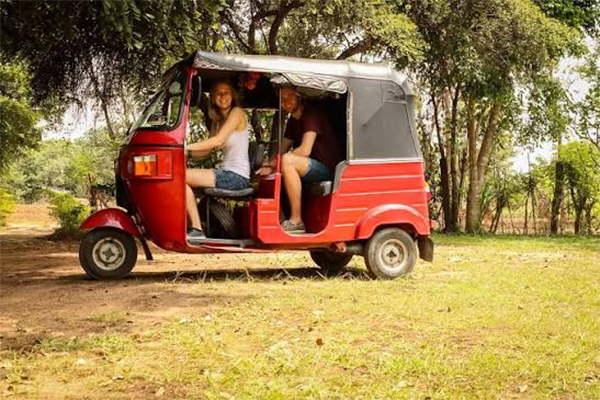
Getting Around Sri Lanka
- Best overall approach: driver for long legs, trains for scenery, PickMe for towns.
- Grab? No. PickMe is the local equivalent, so download it before you land.
- Uber? Yes, in Colombo, Kandy, Galle and Negombo, and it’s expanding. Outside the cities it’s thinner than PickMe.
- Cheapest: buses, at a few dollars for a cross-island ride.
- Most comfortable: a car with driver at $55–75 a day, split between travelers.
- The ride you shouldn’t skip: the Kandy–Ella train. Book the observation car ahead.
- Flagship route: Colombo to Sigiriya, roughly 3.5–4.5 hours by car, or train to Habarana plus a tuk-tuk.
- Self-driving: not on your home license (more on that below).
Sri Lanka at a glance
- Geography: It’s a teardrop-shaped island of about 65,000 square kilometers, roughly the size of Ireland or West Virginia, separated from India by the Palk Strait. It sits in South Asia. With one international airport, Bandaranaike International (BIA) near Colombo, you’re dealing with roads and rails, not domestic hops.
- Time: Sri Lanka Standard Time is UTC+5:30, half an hour off India, with no daylight saving. When it’s noon in London, it’s 5:30 p.m. in Colombo.
- Money: The Sri Lankan rupee (LKR) trades around 300–330 to the US dollar in late 2026. Cash still rules outside the cities, which matters for nearly every fare below.
- Religion: About 70% of the country is Theravada Buddhist, with significant Hindu, Muslim and Christian communities. In practice that means temples everywhere, modest dress at sacred sites, and Poya (full moon) days when the bars close and the roads go quiet.
- History: Three European powers took turns here: the Portuguese from 1505, the Dutch in the 17th century, and the British from 1815 to 1948. You can still see it in the forts, in the railways (the British built them to move tea), and in how widely English is spoken along the tourist trail.
- Known for: Ceylon tea, ancient temples and rock fortresses, elephants and leopards, blue whales, beaches and surf, cinnamon (this is the spice’s true home), gems and cricket.
- Wildlife: Thousands of wild elephants, the world’s densest leopard population in Yala, sloth bears, toque macaques, blue and sperm whales off the south coast, spinner dolphins, crocodiles, and a bird list that draws twitchers from everywhere.
- What you’ll be traveling between: The Cultural Triangle’s ancient cities, Kandy’s Temple of the Tooth, the hill-country train, safaris, whale watching, Galle Fort and the south coast surf towns.
Your five options
| Mode | Cost | Speed | Comfort | Best for |
|---|---|---|---|---|
| Private driver | $55–75/day (car, all-in) | Fast, door to door | High | First trips, families, anyone who values time |
| Train | $1–12 per long leg | Medium | Basic to lovely | The scenic hill-country legs |
| Bus | $0.30–4 per ride | Slow but frequent | Low to medium | Budget travelers, short hops |
| Tuk-tuk (app) | LKR 100–140/km | Fast in towns | Open-air fun | Getting around town |
| Self-drive / tuk-tuk rental | Varies | Medium | Adventurous | The confident and the curious |
Most successful trips use three of these five.
Trains: the scenic spine
Sri Lankan trains are cheap, safe by local road standards, and on the hill-country lines genuinely world-class. The network fans out from Colombo Fort station. One line runs south along the coast to Galle and Matara. Another heads east to Kandy and on through Nuwara Eliya and Ella on the Badulla line. A third goes north to Habarana, Anuradhapura and Trincomalee.
A few things to know:
- Classes matter. Unreserved second and third class are cheap and always available, though in high season that can mean standing. The experiences worth booking are reserved first class and the observation car, a carriage with a rear-facing lounge over the tracks on the scenic lines. They sell out days to weeks ahead from December to April.
- Kandy to Ella is the one to plan around. People regularly call it the most beautiful train ride in the world, and on a first trip it’s the one leg where you really shouldn’t be in a car. Book the observation car early.
- Trains run on Sri Lankan time. Delays are normal, and the scenery doesn’t mind. Leave buffer days around connections.
- Buy from official channels. Use Sri Lanka Railways’ own stations and booking systems, or a reputable agent if you’re after constrained seats. The “sold out” resale sites mark up observation-car seats.
Buses: the budget backbone
Buses go everywhere, for almost nothing. A cross-island ride costs a few dollars and a town hop costs cents. You’ll see two kinds: state-run CTB/SLTB buses and faster private coaches, including air-conditioned expresses on the main corridors.
Now the honest part. Buses are crowded and driven fast, and official government travel advisories single out public buses as the least safe road transport in the country, citing aggressive driving, poor maintenance and theft on crowded runs. Use them for short hops and the occasional long haul when the schedule suits, but don’t build a tight itinerary around them. On board, pay the conductor and keep your bag on your lap.
For the flagship route below, the bus chain works fine. Buses leave Colombo’s Bastian Mawatha terminal in Pettah toward Dambulla, Habarana and Anuradhapura about every 20–30 minutes through the day.
Tuk-tuks and ride-hailing: PickMe, Uber and the Grab question
If you’re coming from Southeast Asia, you’ll want to know this first: Grab doesn’t operate in Sri Lanka. Arrive from Bangkok or Bali with Grab on your phone and it will find you zero drivers. The local equivalent is PickMe, and it’s excellent.
PickMe is the home-grown app the whole country uses, covering tuk-tuks, cars, vans and motorbikes. You get upfront pricing, driver photos and plate numbers, and you can pay in cash or by card. Install it before you land. A typical 10-minute tuk-tuk ride in Colombo runs LKR 200–400, well under a dollar, and tuk-tuk tariffs run roughly LKR 100–140 per kilometer.
Uber works too. It’s reliable in Greater Colombo and Negombo, including airport pickups from BIA (an Uber into the city runs roughly LKR 5,000–8,000), and its coverage in Kandy, Galle and other major towns has grown through 2025–26. Outside the metros it’s thinner than PickMe. My advice is to install both, compare prices when both show a car, and treat PickMe as your island-wide default.
Coverage fades quickly outside cities and resort towns. In Ella, Weligama, Mirissa and around Sigiriya, an app driver may accept and then cancel, or run into friction at the pickup. Your guesthouse can usually arrange a tuk-tuk or transfer, or you can agree a fare with a street driver before you climb in. Think of the apps as your price anchor and guesthouses as your rural network.
Street tuk-tuks are everywhere and negotiable. Settle the fare first (roughly LKR 100–150 per kilometer). Better still, open PickMe and show the quoted price. It’s the best negotiating tool in the country.
Private drivers: the first-timer’s default
For most first-time visitors, a car with a driver is how Sri Lanka gets done. A sedan runs $55–75 per day, including fuel and the driver’s own costs, since most tourist hotels provide free driver quarters. A van is $80–120. Split between two or four travelers, that’s less than many Western airport taxi rides. The driver takes care of navigation, bargaining, bus stations and all the small logistics that eat up travel days.
Book through recommendations, established agencies or your hotels. Agree the route and what’s included before you set off, and expect to tip $5–10 a day at the end. Traveling without a driver is doable, but it costs you pace.
Self-driving and tuk-tuk rentals
Can you drive on your home license? No. Sri Lanka doesn’t recognize foreign or international licenses for visitors. Legal driving requires a Sri Lankan recognition permit from the Department of Motor Traffic, which means an in-country application, a test and some time. Rental firms that hand over keys on a home license are handing you legal exposure, because an invalid license can void your insurance and complicate everything after an accident.
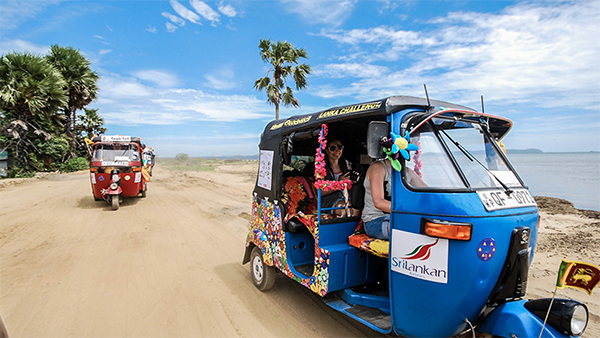
What travelers actually love instead is renting a tuk-tuk. Specialist companies rent three-wheelers to tourists and handle the permit paperwork, insurance and route support as part of the deal. It’s slower, louder and more exposed than a car, and miserable in the rain. But with your luggage under the seat and the island rolling by at tuk-tuk pace, it has passionate fans. Stick with an established operator and never rent from the roadside.
Domestic flights
They’re limited and rarely worth it. There’s one main international airport and a small domestic scene: seaplane services (the best-known operator flies scheduled floatplane routes between Colombo’s lake, Kandy, the south coast and the east) plus a few small fixed-wing operators. The seaplane is scenic and can save time, with Kandy in 30 minutes instead of four hours. But it’s priced as a luxury, depends on the weather and only runs on certain days. Since nothing on the island is more than a day’s drive, most people fly in and drive around.
Getting from Colombo to Sigiriya
It’s about 175 km, and the real variables are time, cost and comfort.
| Method | Time | Cost (per person) | Notes |
|---|---|---|---|
| Private car/taxi | ~3.5–4.5 hours | ~$60–110 total for the car | Door to door; the standard |
| Train + tuk-tuk | ~5–6.5 hours | ~$6–13 | Colombo Fort to Habarana, then 15 km by road |
| Bus + tuk-tuk | ~5–7 hours | ~$5 | Bastian Mawatha to Dambulla/Inamaluwa, then local |
| Tour transfer | ~4 hours | Varies | Many Kandy-and-hills tours include it |
By car is the default. Book through your hotel, an airport driver or an agency. From Bandaranaike International, most people head straight to Sigiriya (about 3.5 hours via the expressway and north road) instead of sleeping in Colombo, which makes sense after an evening arrival.
By train, there’s no station at Sigiriya, so the handoff is Habarana, about 15–25 km away. Roughly three direct trains a day leave Colombo Fort (early morning, mid-afternoon and late evening; the mid-afternoon is the popular one) and take 4.5–5.5 hours. Fares run from about LKR 360 in unreserved third class to roughly LKR 1,560 reserved third and LKR 3,250 first class. From Habarana, a tuk-tuk or taxi covers the last 25–40 minutes (about LKR 2,500 by taxi, less by tuk-tuk), or your guesthouse can collect you, which is the standard move. Check times on the official Sri Lanka Railways schedule before committing, because services change.
By bus, take one from Bastian Mawatha in Pettah toward Anuradhapura, Kaduruwela (Polonnaruwa) or Trincomalee. Ask to be dropped at Inamaluwa Junction (the Sigiriya turnoff, about 10 km out) or Dambulla (the bigger hub, about 20 km out), then take a local bus or tuk-tuk the rest of the way. Air-conditioned services cost around LKR 1,300 and ordinary buses less. The whole trip takes 5–7 hours. It’s the cheapest and most committed option, worth it for the experience or the budget but not for the schedule.
What it all costs
Here’s a transport budget for a two-week classic loop, per person with two sharing, at 2026 prices:
| Transport plan | Two weeks (per person, two sharing) |
|---|---|
| Driver for ~10 driving days ($55–75/day, split) | $275–375 |
| Trains: Colombo–Kandy, Kandy–Ella (reserved) | $10–25 |
| Tuk-tuks and app rides around towns | $30–60 |
| Airport transfers (Uber/PickMe or driver) | $15–40 |
| Total | roughly $330–500 |
For comparison, the bus-and-train-only version of the same loop costs under $50 per person. What you really pay there is time, about a day of it across two weeks. The all-driver version, with no trains or buses at all, runs $550–800 per person split two ways. So the cost is whatever you want it to be, and the middle option is both the cheapest comfortable plan and the most fun.
Matching transport to your itinerary
- The classic loop (Colombo, Cultural Triangle, Kandy, Ella, south coast): driver for the Triangle and the south, train from Kandy to Ella, apps in the towns. This is the stack at its best.
- Short on time: use a driver throughout. You’ll cover more, in more comfort, in a week than public transport manages in ten days.
- Budget version: buses and trains end to end, with tuk-tuks at the edges. It’s the cheapest and slowest option, and it works best with a flexible schedule.
- East-coast variant (May–September): driver, or train and bus, to Trincomalee and Arugam Bay. The east is less touristed and the transport thinner, so pre-book the long legs.
- Golden rules: avoid any single leg over four hours by road if you can, stay two nights minimum per base, and book the Kandy–Ella observation car before the hotels.
Traveling independently
Fully independent travel, with buses, trains, tuk-tuks and guesthouses booked as you go, is more than possible here. It’s something of a rite of passage, and it gets you encounters a car window filters out. A few notes:
- English is widespread along the tourist trail, and Google Maps covers the island well.
- Cash is still king at small guesthouses, with bus conductors and at roadside stalls, so plan your ATM stops.
- The roads are the main safety risk, and buses are the wildcard. Cross carefully. Petty theft happens on crowded transport. Solo female travelers should know that harassment is a real issue and deserves honest treatment, not dismissal.
- Save the tourist police hotline, 1912, in your phone.
- Build slack. The biggest independent-travel mistake in Sri Lanka is a tight schedule. The transport is wonderful and approximate, and a missed bus is just an extra king coconut and a story.
Airport arrivals: the first leg
The stack starts at Bandaranaike International, and your first decision is whether to sleep in Colombo or push on. After a daytime arrival, most people head to Negombo (20 minutes away, beachy and calmer) or straight to the Cultural Triangle (3.5 hours). After a night arrival, stay in Negombo or Colombo and start early.
To get into the city, you have three choices. The Route 187 airport bus runs 24 hours from the departures-side porch to Colombo Fort for about LKR 325, plus a baggage charge over 23 kg. An Uber or PickMe from the arrivals forecourt costs roughly LKR 5,000–8,000 to central Colombo. Hotel transfers run $40–60 and are usually the worst value of the three. If your driver is meeting you, which is the best way to arrive, none of this matters. Look for your name on a sign and hand over the logistics.
Wildlife on the roads
The guidebooks underplay this one: Sri Lanka’s roads run through wild country. In the Cultural Triangle and the east, wild elephants cross roads and sometimes just stand in them. If you meet one, stop, stay quiet and wait. Don’t approach, don’t honk, and never get between a mother and her calf. Cattle and dogs are constant on rural roads, and the monkeys at temple sites will take anything that isn’t attached to you. It’s part of what makes getting around here feel like nowhere else.
Final thoughts
PickMe before you land, a driver for the long legs, the observation car for the hills, buses when the budget calls for it, and a tuk-tuk haggle anchored by the app’s price. In practice: land at BIA, take an Uber or PickMe into Colombo, meet your driver, ride the trains where the trains are the point, and let guesthouses fill the rural gaps.
FAQ
Is there Grab in Sri Lanka?
No. The local equivalent is PickMe, which covers tuk-tuks, cars, vans and motorbikes with upfront pricing and cash or card payment. Install it before you land, and keep Uber as a backup in Colombo and the major towns.
Does Uber work in Sri Lanka?
Yes. It’s reliable in Greater Colombo and Negombo, including BIA, where a ride into the city costs roughly LKR 5,000–8,000, and it covers Kandy, Galle and other major towns. Outside the metros it’s thinner than PickMe, so install both.
How do I get from Colombo to Sigiriya?
The standard is a private car (about 3.5–4.5 hours, $60–110 for the car). By train, take Colombo Fort to Habarana (about 4.5–5.5 hours, from roughly LKR 360 unreserved to LKR 3,250 first class), then a tuk-tuk or taxi for the last 15–25 km. By bus, take a Pettah bus toward Anuradhapura or Trincomalee, get off at Inamaluwa Junction or Dambulla, and take a local connection. That’s about 5–7 hours total.
Do I need a private driver?
For most first trips, yes. A car with driver ($55–75 a day including fuel and the driver’s costs) removes nearly all the logistical friction. You can go without one, but it costs you pace. The sweet spot is a driver for most legs and the train for Kandy–Ella.
Are buses safe?
They’re functional and extremely cheap, but official travel advisories flag them as the least safe road transport because of aggressive driving, crowding and theft. They’re fine for short hops, and most travelers avoid building an itinerary around them.
Can foreigners drive in Sri Lanka?
Not on a home or international license. You need a local recognition permit obtained in-country. The popular alternative is renting a tuk-tuk from a specialist company that arranges the permit paperwork.
Are the trains worth it?
Yes, especially Kandy to Ella through the hill country, one of the world’s most scenic rail journeys. Book the reserved observation car or first class ahead for December–April, because unreserved carriages risk standing.
Is Sri Lanka an island, and what continent is it on?
Yes, it’s a teardrop-shaped island off the southern tip of India, separated by the Palk Strait, in South Asia. At about 65,000 sq km, it’s small enough that one airport plus roads and railways carry almost all travel.
EXTERNAL SOURCE RECOMMENDATIONS
Claims in the article that should carry (or be verified against) authoritative outbound links at publish time:
- Train schedules and fares (Colombo–Habarana): Sri Lanka Railways — https://www.railway.gov.lk (official timetable and fare pages; the article’s specific departures and prices should be re-verified here before publication).
- Bus routes and terminals: SLTB — https://sltb.eseat.lk where available, plus current route resources for Bastian Mawatha departures.
- Airport bus (Route 187): Airport and Aviation Services — https://www.airport.lk (the official route and fare).
- Driving permit requirements: Department of Motor Traffic — https://www.dmt.gov.lk (the recognition-permit rule for foreign licenses).
- Ride-hailing facts (PickMe services and vehicle types): PickMe — https://pickme.lk/services/ride/ (the official service pages).
- Bus-safety advisory: US State Department — https://travel.state.gov/en/international-travel/travel-advisories/sri-lanka.html and/or Canada — https://travel.gc.ca/destinations/sri-lanka (both flag public bus safety).
- Time zone: a standard reference (e.g., com‘s Sri Lanka page) for UTC+5:30.
- Country facts (area, religion split, colonization dates, wildlife): Sri Lanka Tourism — https://www.srilanka.travel; the Department of Census and Statistics — http://www.statistics.gov.lk (religion figures); UNESCO — https://whc.unesco.org/en/statesparties/lk (World Heritage context). Present religion and wildlife figures as approximations from census and tourism sources.
Related Articles
- Travel Checklist: Essential Packing and Trip Preparation Guide
- Sri Lanka Packing List: What to Pack for Any Trip (2026)
- Is Sri Lanka Safe to Visit? A Straight Answer for 2026
- Getting Around Sri Lanka: Transport Guide (Trains, Drivers, Apps)
- Travel Checklist: Essential Packing and Trip Preparation Guide
- Sri Lanka Cultural Triangle Itinerary: 3, 4 or 5 Days (2026)
- Sri Lanka Honeymoon Itinerary: 5, 7 or 10 Days (2026 Guide)
- what to see in sri lanka in 7 days
- How much money to take to Sri Lanka for 2 weeks: Sri Lanka Travel Budget (2026 Costs)
- Best Time to Visit Sri Lanka: A Month-by-Month Guide for Every Trip
- Sri Lanka Visa for US Citizens: The Complete 2026 ETA Guide
- how to be a travel guide in sri lanka : Itineraries, Costs, Visas & Tips
Editor – Jayamanna